
The Addington (revised)
- Neil White
- Dec 9, 2025
- 4 min read

"Our key aim is to restore one of the finest Golden Age courses in the British Isles and couple it with first-class hospitality and service."
If the astounding work on The Addington’s course is replicated across all other facets of the club, its owner’s vision will surely be fulfilled.

Ryan Noades took over at the helm of the South London club a few months before my last visit in 2020.
At that time, I celebrated some decent golf on a heavily tree-lined course with pacy greens and quirky holes.

In my review, I noted playing with a friendly and knowledgeable member, "who pointed out that the owner has a five-year plan to bring the club back to the glories of its early days.
'It is pretty damned good now, so I can't wait to see how it progresses,'” I wrote.
Five years later, I returned with my podcast partner.

A glimpse of the course from the car park was all it took to see the difference. “Where have all the trees gone?” I remarked, looking across three holes towards the course’s highest point.
The answer is that hundreds, if not thousands, have been removed, giving the course a feel more like that laid down by famous architects John Abercromby and Harry Colt.
While the risk of losing a ball is reduced, I don’t believe the challenge is diminished.

Success is most likely found through strategy rather than brute force, and a tip-top short game is required for a stellar score.
The wind was fierce during the front nine, but worked in my favour as I posted a par-three on the first and a par-five on the second.
Removing the tree and bush on both holes has introduced light and exposed green run-offs that will filter away imprecise shots.

The third, a 220-yard uphill par-three into the wind from the new tee, was the most difficult on this day.
Shots that don’t reach the green will see balls take the sharp left-to-right slope towards two bunkers.

There are only 37 sand traps, but they are so well placed that some will almost certainly be found during a round. This is no great hardship, though; the white sand is so fine that it allows for prompt escape.
The fourth is the stroke-index one and, despite the wider fairway, still has plenty of teeth against the wind.
Its green complex has a links feel, so I putted from 15 yards short of it, watching my ball take the bank and undulation before sliding an inch past the cup.

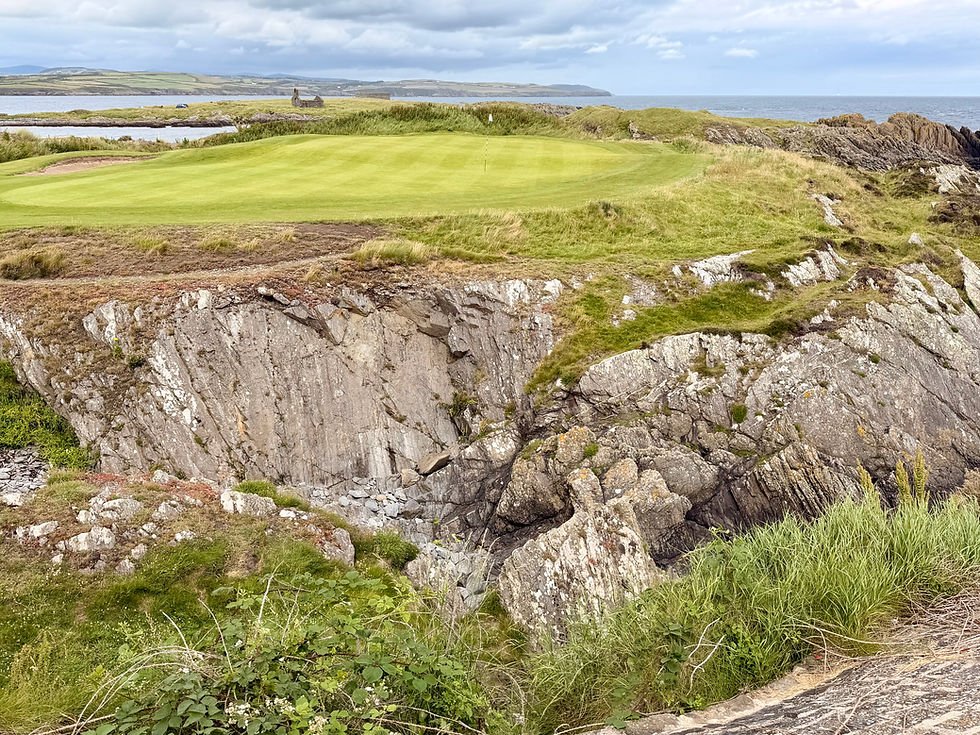
The sixth remains a stand-out par-four because of the deep grassy chasm to the right of the target. My drive was wide right, and I duffed my approach into heather at the edge of the abyss.
Following a drop, I bounced the ball on one of The Addington’s famous bridges onto the putting surface.

The new seventh was out of commission when we played because its green is being extended to become the biggest on the course.
It looks impressive, if daunting. The eighth hole was a dogleg par-four, requiring a blind drive and a long approach over a dip. If the ball is short, it will likely be propelled into the rough on the left.

Comedy came on the par-four ninth when I topped my approach, feared it would go into a grassy gorge and watched incredulously as it rolled across the bridge.
There are now 19 holes at The Addington.

The brand new one is called Perdu (or ‘lost’). This green was discovered during the renovation as an alternative to the 12th.
It has now been made into a gorgeous short par-three with a superb, if very tricky, putting surface.

I remembered the 12th so vividly because I birdied it on my last visit. It remains a wonderful par-five that falls past two tiers of fairway and a heather oasis.
It then rises via a ramped fairway to a green that drops sharply from left to right.

The restoration on the 13th has sparked much debate due to the removal of its hallmark rhododendron bushes.
It is still a heck of a par-three at 230 yards from the white tee, and our host narrowly missed a tremendous birdie after a stunning tee shot.
The most memorable element of the changes has been the opening up of views of central London.

This 'wow factor' had previously been reserved for the tee on the par-four 14th, from which The Shard can be seen. Now, a panorama of the city can be viewed from various parts of the course. The vistas are simply stunning.
The 14th became more memorable for me because my drive found a hump on the fairway known as Moira’s Minge, "in honour" of a previous owner.
Perhaps inspired by the anecdote, I laced my approach from there to 12 feet.

Our host told us his favourite hole was the 15th – a long uphill par-four that funnels into a multi-tiered, heavily sloping green from the right. The 17th remains a remarkable par-three, 195 yards over a bridged chasm and bunker.
I saved my best for the last – a 435-yard par four with trees down the right and a big bunker on the left. My approach drifted onto the green and left me a 20-foot putt for birdie. Sadly, I had to settle for par.
However, the overriding memory of the day will not be my play but the incredible reinvention of the golf course. Remarkably, the holes have barely been changed and yet feel so different.
The project is far from complete, so I look forward to returning to see how it develops with an even greater thirst than I had five years ago.


Comments