
Cleeve Hill
- Neil White
- Mar 2
- 4 min read

WARNING – You might have fun on this golf course, irrespective of handicap, gender or belief.
So says the lovely sign that mimics—or perhaps mocks—the famous one at Bethpage Black. Indeed, Cleeve Hill is for everyone and is more than just fun; it is an adventure.
I had been told so much about this Cotswolds classic that I was desperate to play there. That desire became an obligation once it entered England’s new top 100 listing.

The course evokes thoughts of the rawest of the UK’s acclaimed layouts—think a mix of Kington, Brora and Royal North Devon. Yet those echoes are only fleeting because Cleeve Hill is unique.
Much of its character stems from its pedigree; originally laid out by Old Tom Morris in 1891, it possesses a rugged, "mountain-links" soul.
What makes it different? Its history, the quality of its holes, the turf shared with non-golfers and sheep, and the views… boy, those views.

Standing at the summit of the Cotswold Edge—the highest point in Gloucestershire at over 1,000 feet—the panorama is breathtaking.
Beyond Cheltenham Racecourse (home of the fabled Gold Cup) and Tewkesbury Abbey, you can just about see the Severn Bridge to Wales.
We were incredibly lucky; this was the clearest winter day in weeks, meaning we avoided the infamous "Cleeve Cloud" mist that often swallows the hill. Instead, every hole was set against a backdrop akin to a painting.

To be kind, the clubhouse is rustic. The great news, however, is that planning permission for a completely new building and car park has been approved, with work due to begin this summer.
The first hole offers a glimpse of the drama that unfolds as the game progresses. Next to the tee is a limestone chasm; such craters become a familiar sight.
The opener is a par-five and, like several holes, requires a blind tee shot to a very wide fairway. The real question is posed by the approach, which requires a right-to-left trajectory.

Most of the greens here are small compared to championship courses and feature startlingly steep run-offs—none more so than on the short par-four second.
Each of our four-ball had pitches into the green after negotiating a blind tee shot.
However, only Mrs W walked away with two Stableford points; the rest of us floundered around a green that runs steeply from back to front.

I was short with my approach and left with a vertical chip from a tight lie, which I messed up. The comedy came from my Podcast Partner, who found the green in three only to watch his putt flow past the hole and 30 yards back down the fairway!
The third is equally intense, with a target on a shelf that can only be found by a ball played well to the right and at a perfect length. Anything else will slip down a 45-degree slope.
I huffed and puffed—literally on the walk and metaphorically in my golf—but there was a golden moment on the fifth. This par-four was downwind, and I took advantage with an eight-iron approach to ten feet before sinking the birdie putt.

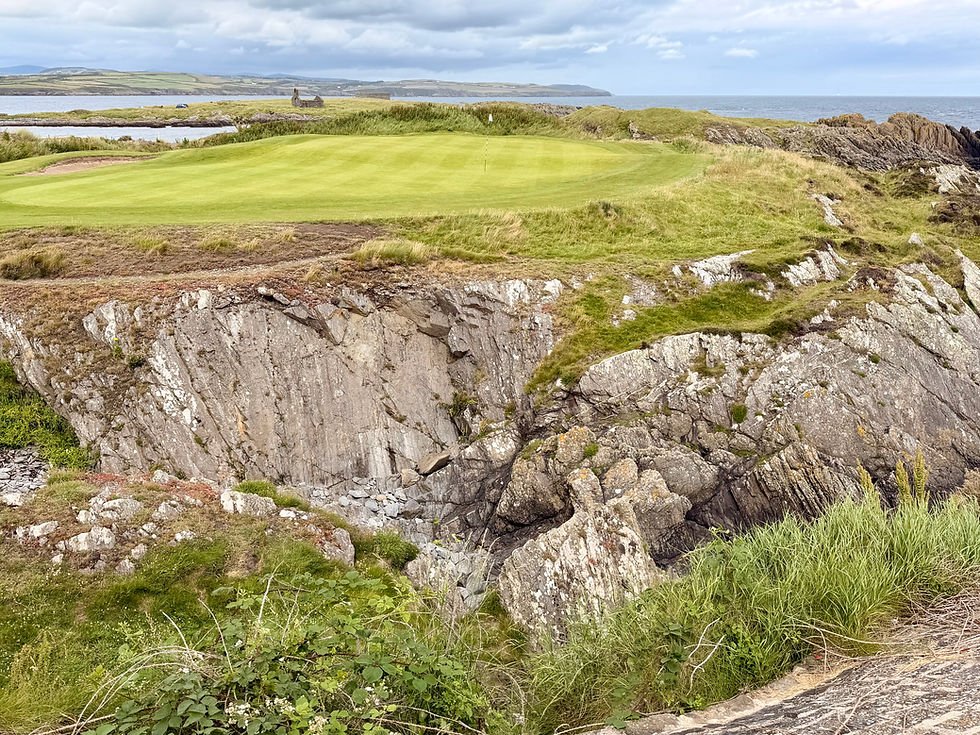
I gasped when I stood on the sixth tee. This short par-three plays over the remnants of limestone excavations to a green perched on a plateau.
To the right lies a deep quarry—the equivalent of the deepest bunker I have ever seen. Apparently, there is no free drop if your ball is impeded by the Cotswold stone at the bottom.

The most intimidating drive is the elevated shot into the wind on the ninth, onto a fairway that falls from right to left.
It is followed by an approach that must fly in from the right to avoid the ball tumbling down a slope into another treacherous natural dip on the left.
At this point, it is worth remembering that there is no irrigation at Cleeve Hill, and sheep handle most of the greenkeeping. Meanwhile, the old quarries and gorse provide habitats for myriad plants and wildlife.

The hits keep coming with the spellbinding 10th—a fabulous downhill par-three of about 200 yards with bushes flanking the right.
We had also heard much about the par-five 13th but wondered what the fuss was about as we hit our drives over the marker post into a wide fairway.
Then came the reveal. It was staggering. The green sits on the site of an Iron Age hill fort and is surrounded by its original moat. Directly behind are incredible views of Cheltenham.

Fortunately, I did the hole justice, leaving a 20ft putt for birdie. While the attempt was meek, it resulted in a comfortable par.
The show was far from over. The back-to-back par-threes at the 15th and 16th are tremendous.

We were glad we hadn’t realised how deep the gorge was in front of the 15th until after our balls had sailed onto the green, unhindered by negative thoughts.
The uphill 16th is partially hidden by rolling terrain, with a wildly sloping green acting as the "kick in the tail." I can attest that finding the putting surface from the tee is no guarantee of par.

The strokesaver claims it is possible to hit the green of the 400-yard par-four 17th from the tee.
That seemed fanciful, but Mrs W and I both hit mighty drives over the marker post before the ground plunged severely downhill.

We luckily missed the hidden quarry on the left but were foxed by the right-to-left approach into a green that falls markedly from front to back.
The 18th plays downhill towards the clubhouse over a series of fairway ripples to a tricky green situated beside another substantial fenced chasm.

It completes one of the most invigorating rounds in the country. The walk across the hills and hollows of Cleeve Hill certainly made our legs ache, but we smiled throughout.
This is, indeed, one of the most fun rounds in the UK—regardless of handicap, gender or belief.



Comments