
Paraparaumu Beach
- Neil White
- Mar 9
- 4 min read

From about 12 feet, Mrs W steered her birdie putt towards the cup and performed a jig of delight as it disappeared. Meanwhile, my approach had slunk down the side of the green, leaving me facing a near-vertical chip.
The ball reached the top of the bank before shooting across the putting surface to the fringe on the opposite side. My recovery was also too firm, sending me back to where I had started.
This time, I opted to putt and finally found the dancefloor. Two taps later, I had recorded a seven.

So ended Paraparaumu Beach’s 17th, noted by Golf Magazine as one of the 500 greatest golf holes in the world. Mrs W’s triumph—four Stableford points to my nil—earned her a well-deserved victory on a course we enjoyed immensely.
Paraparaumu Beach was bustling with both members and visitors on the Saturday we visited.
The club was also busy preparing for the New Zealand PGA Championship, which was the first tour event since the 2002 New Zealand Open, when Tiger Woods famously headlined the field.

Nevertheless, the welcome was warm, the pre-round ginger cake was lovely, and my practice on the putting green was determined, given the short game wobbles I’d experienced on this trip. Sadly, I quickly proved that I needed more than just a little self-adjustment.
The two main surprises of the course were its relative shortness and the total lack of sea views. However, there is plenty to keep one occupied, as the undulations and green run-offs are incredibly dramatic.
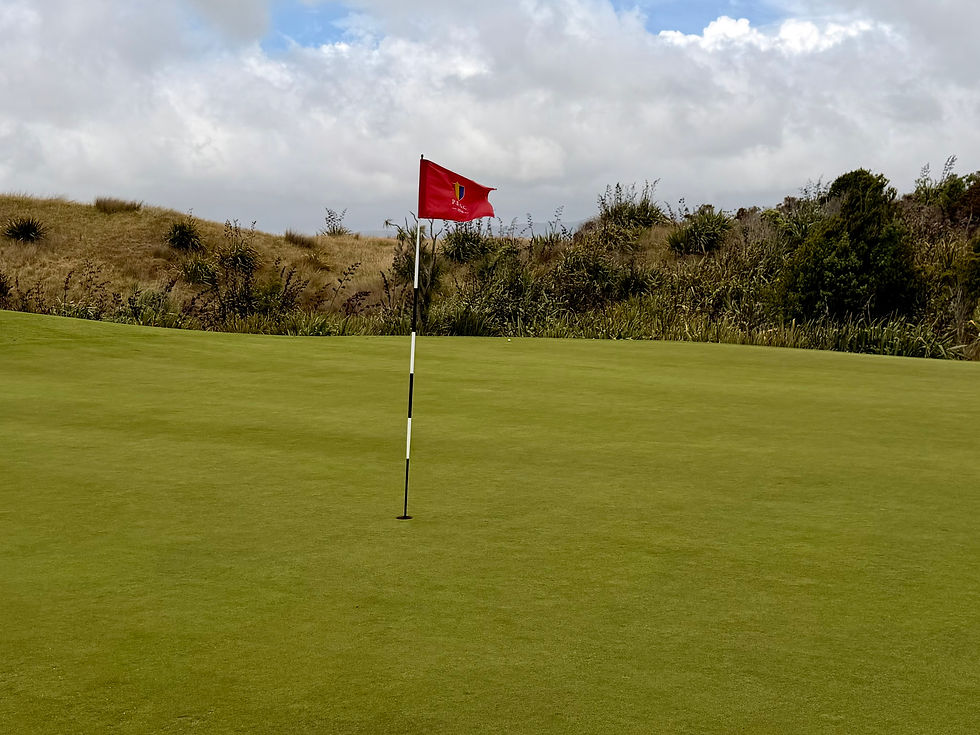
These bumps and hollows are evident from the first hole, where the group ahead of us fired drives into the grassy dunes flanking the left of the fairway.
I was pleased to find the short stuff and crack my approach to the right side of the green.
However, the joy of a birdie putt on the opener soon turned into a nightmare; I misjudged the pace, and the ball trundled on and on, caught a slope, and finished on the fringe. I three-putted from there for a six.

Between then and the 17th, I played reasonably well, though not as handsomely as Mrs W, whose impressive short game matched her excellent driving.
Her first par came at the par-three second, which demands a shot over rolling ground to a green defended by a pot bunker on the left and a steep bank at the rear.
I three-putted from just short of the putting surface—though, at the very least, that was one stroke better than Tiger’s infamous struggle there!

The slight breeze was at our backs for the fourth: a par-four of more than 400 yards for men and 100 yards less for women.
The fairway is narrower than most, and the green must be approached from the left to avoid sand traps. Both of us nailed very pleasing pars.
This was followed by a Paraparaumu classic. The fifth is a short par-three with no bunkers, but its “pulpit” green sits atop steep drop-offs. Mrs W found the target and secured a comfortable par.
I ended up in the left swale and tried to putt up the hill; a bogey ensued. Five holes in, and my wife had won them all.

The sixth had me licking my lips, measuring only 270 yards from the blue tees. However, the fairway undulations kick the ball in unexpected directions toward a rippled green flanked by traps. It certainly has more "teeth" than it first appears.
The eighth encapsulated the fun of the course for me. It’s a short, bending par-four with out-of-bounds stakes guarding properties on the left.
I was left with only 110 yards into the sunken green, but the pitch was blind, and I landed three yards short.

It shares a similar character with the ninth, which is wedged between the practice area and the clubhouse. My drive didn’t clear the hill, obscuring the green, but my blind approach turned out to be one of my best shots of the day.
Modern golf may be obsessed with power, but it was a rare pleasure to play a course that poses questions of strategy rather than just distance.

Alex Russell’s design is clever because it offers players of all abilities a chance to score well while remaining a stern test for those who are inaccurate with their yardage or angles.
The 11th is the tightest hole on the course, with homes and a stream to the left. We both claimed two Stableford points, but the hole will be remembered as the place I mislaid my mobile phone.
For the next four holes, I had that sick feeling in the pit of my stomach that I might never see it again.

Nevertheless, we ploughed on down the par-five 12th and through to the brilliant 13th—acclaimed by some as the world’s best bunkerless hole.
The ground rises and falls repeatedly; it would be gorgeous even without the Tararua Mountain Range as a backdrop. I was thrilled to land my second shot on the fringe, but I found the slopes trickier than Mrs W, who closed out our matchplay game with a glorious long putt for par.

The green fall-offs became positively outrageous on the home stretch.
Following a blind drive on the 15th, the approach must stay right to avoid a bank that funnels the ball into a deep gully.

The real highlight of the hole, however, was my mother calling Mrs W from England to say my phone had been found! It was 3.30 am her time.
The par-three 16th is outstanding, featuring a dune to the left and a steep fall-off to the right. Somehow, my ball clung to the surface, leaving me a ten-foot birdie putt which I narrowly missed.
By then, the assistant pro had delivered my phone via buggy, and I was elated.

Despite my matchplay defeat, I was still one point up in our Stableford game. That lead vanished on the 17th.
From the tee, one can choose the wider left-side route or the narrower, shorter right side. We both went left, and the aforementioned 4-0 scoreline followed.

On the par-five 18th, a temporary building for the PGA had been erected beside the green—a hole that will surely yield birdies for the pros.
Mrs W finished in style to secure her double victory, completing a round that was different from what we expected but immense fun.
Anyone can play Paraparaumu without feeling intimidated, and I heartily recommend it.


Comments