
Royal County Down
Updated: Jun 2

From the moment I first began the quest to play great golf courses, there were certain names that created a tingle of anticipation.
I may never reach Cypress Point or Augusta, but I have now played the Old Course at St Andrews and the magnificent Royal County Down.
This is the highest-rated course I have ever played, so unsurprisingly, I was giddy with excitement to be driving through its gates.

And, for once, I can say that my golf matched my environment. Indeed, I have probably never played better.
Our day at RCD began early. We arrived at 6.45 am for a 7.30 am tee time with the General Manager, Bill Donald, and the now-retired, long-time club professional Kevan Whitson.
To our surprise, Bill had organised a senior caddie for each of us. Mine, Dean Murphy, turned out to be the most in sync with my game of any who have held my bag.

It transpires that Dean has never played golf, but he has been a fixture at RCD for 25 years and knew every line and potential pitfall as if they were in his own living room. He guided me like an expert Sherpa up my sporting Everest.
Royal County Down is high on the international bucket list, so there is a hearty welcome in a pro’s shop that is stocked to the gunwales with merchandise.
The garden in front of its mighty clubhouse is a sea of colour, boasting a Chelsea Flower Show-standard arrangement.
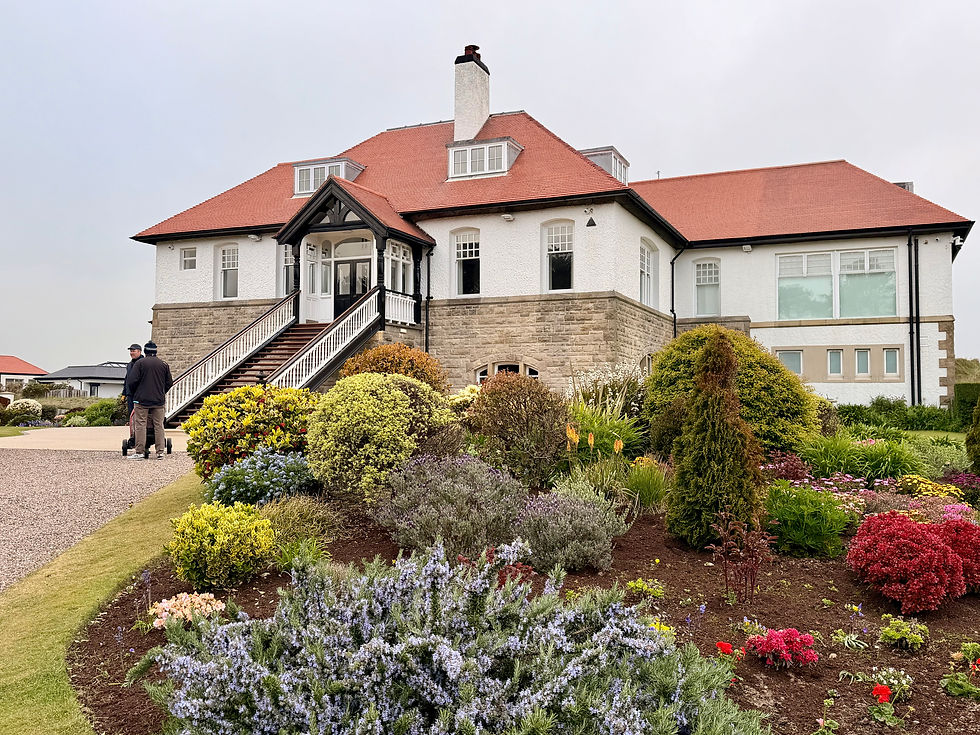
There are three putting greens, including a former croquet lawn, and a chipping area where I concentrated on some much-needed bunker practice.
Podcast Partner (PP) and I were offered a shuttle to the nearby driving range but were keen to spend more time honing our respective short games.
It was windy and had been raining in the early morning, but a rainbow over the Mountains of Mourne signalled that we were to find gold and, boy, we surely did.

George L. Baillie laid out the original nine holes, which were later extended to 18 by Old Tom Morris. Harry Vardon, Harry Colt and, more recently, Martin Ebert have made subtle changes, but this remains golf as it was originally meant to be played.
After shaking hands with the starter, I stood with a slight tremble on the first tee ahead of a drive between the dunes, with the wind slanting from left to right.
I cracked it down the middle and was advised to leave my second shot 100 yards short of the narrow entrance to the long green. I did just that, found the putting surface and began with a par. The relief was almost tangible.
The second features the first of the famous blind drives, so I followed my caddie’s advice to aim left before being confronted by a gap between two sandhills filled with a giant cross bunker. Avoiding sand was a priority, and a five on this par-four was no disgrace.
"Take your camera," was the instruction as we made our way to the third tee, which runs alongside the shore of Dundrum Bay.
It was sound advice – the course sits at the foot of the mountains and right against the sea, with the red-brick Victorian grandeur of the Slieve Donard Hotel looming in the background.

There are a multitude of photo opportunities, but this may well be the best.
The third has a reputation for being brutal. Hollows, dunes, and the course’s trademark "bearded" bunkers—with their deep, shaggy fringes of marram grass and fescue—abound.
Yet, with the wise words of my caddie ringing in my ears, I nailed a 20-footer for a par that warmed my soul.

Those opening three holes were remarkable, but the fourth, considered to be one of the finest par-threes in the world, revs it up even further.
A sea of gorse greets the player from an elevated tee, with the mountains framing the green beyond. I could have sat there all day just to breathe in that view.
With quivering arms, I took aim and hit left. I just missed my par putt, but there was certainly no shame in a four.
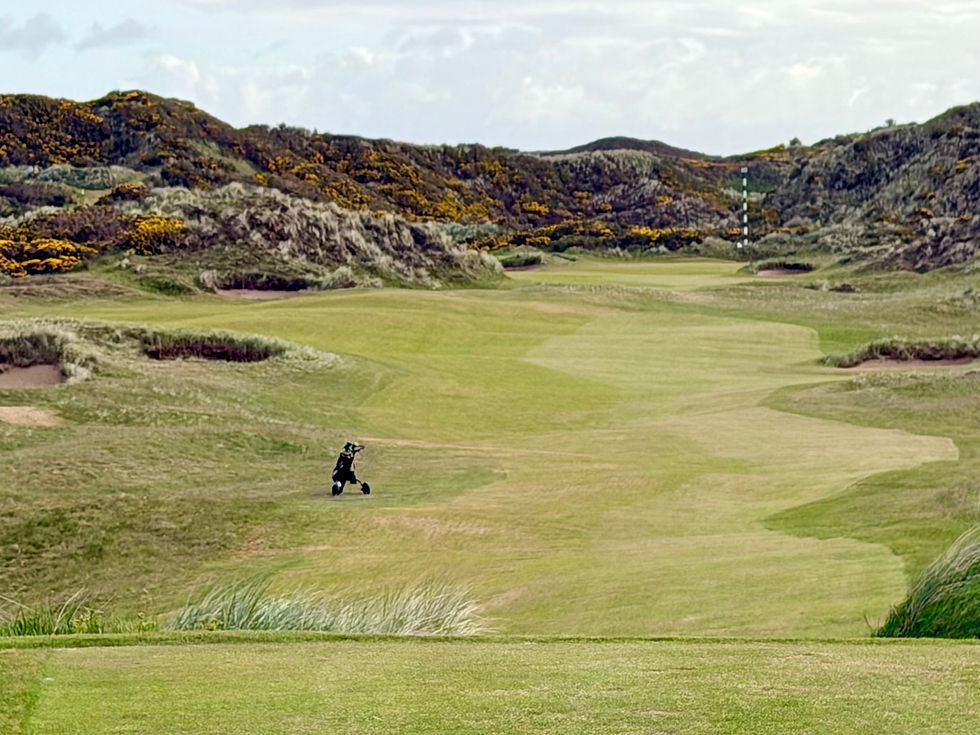
The dogleg par-four fifth will linger long in my memory. I hit a drive that even surprised Dean, because it flew the corner and rested in a bunker.
The temptation was to launch the ball towards the green 175 yards away, but with more traps lurking down the right, I took my medicine, knocked it out with a sand wedge, clipped it towards the flag and nailed another long putt for par.
PP gave me a congratulatory tap on the shoulder, knowing that I was having the time of my life.

I should say that the conditioning of RCD sets a benchmark. The fairway undulations mean that there is very rarely a flat lie, but the turf is so good that this never causes a problem.
The greens have subtle borrows, but a great caddie can point the way to success.
Meanwhile, the hazards are fair, with plenty of room to extricate the ball if you avoid the thickest of the bearded brows.

I digress.
The eighth is the stroke-index one, with big bunkers on either side of the rolling fairway.
After a pleasing drive, I took out my three-wood and struck the ball as well as I possibly could down the right, only to watch it reach the table-top green and disappear down an alarming fall-off to the left.
With the spire of the Slieve Donard Hotel and the mountains in the background, the ninth is another world-class hole, completing what many consider the finest front nine in golf.
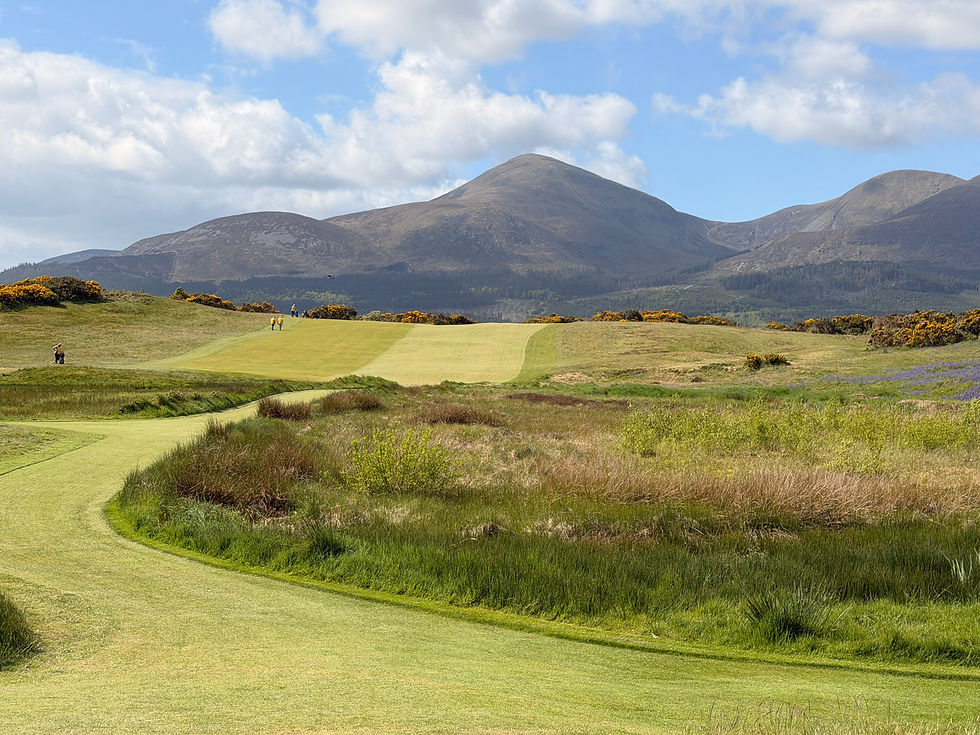
From the tee, the drive is blind over a huge ridge before the land drops 60 feet to the fairway below. My ball came to rest at the base of a dune, so I was forced to hack out and work the ball between the hillocks to the raised green. Alas, a three-putt resulted in the first six of the day.
After a welcome cup of coffee on a colder-than-usual spring day, we took on the back nine.
While the landscape here becomes slightly flatter and more traditional, yet more excitement quickly reveals itself.
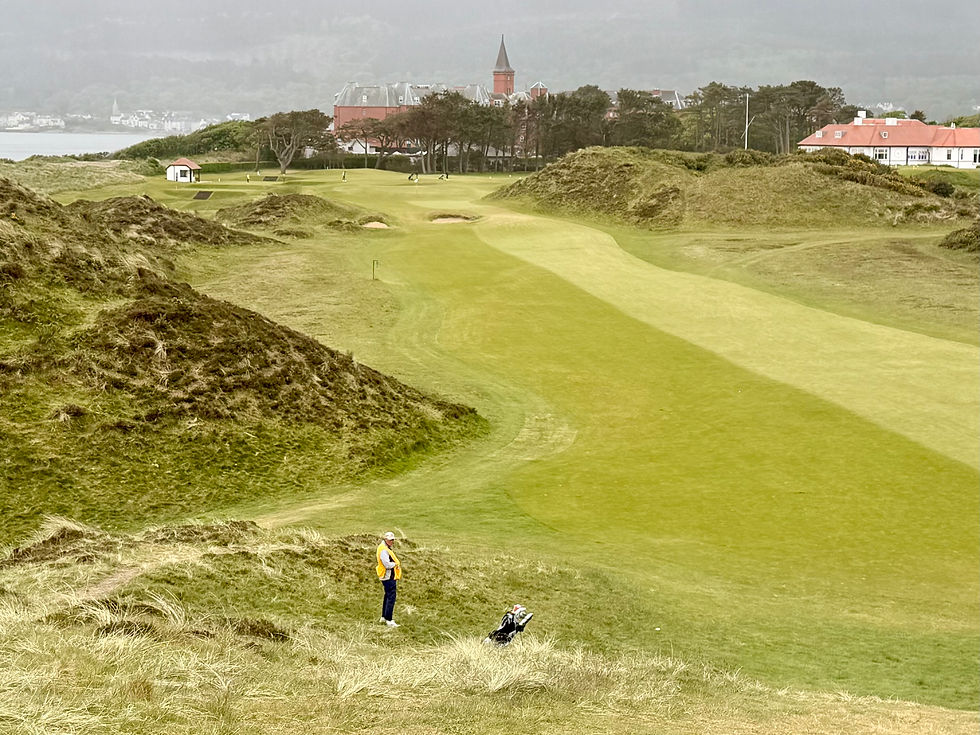
The tenth is a gorgeous par-three away from the clubhouse into a green surrounded by dunes. My tee shot fell short of the target, but my caddie told me exactly where to land my chip, and the ball missed the hole by a mere two inches.
The dream continued on the par-five 11th with one of the most nerve-wracking drives imaginable.
This is an almost vertical ascent over a ridge where three of our caddies waited to spot our respective balls. I hit slightly to the right while, hilariously, PP prompted one of the lads to duck from his pull to the left.

Thereafter, the fairway opens up and, despite sand traps on either side, it is reachable in regulation.
The standout of the homeward nine is the par-four 13th, with a fairway that snakes through a valley of dunes.
Even after a good drive, you are faced with a terrifying, completely blind approach shot over a heather-clad ridge. There is trouble aplenty on the right with bunkers, and beyond the undulating green lie gorse bushes.

Because it is a site of such historical and environmental importance, any alterations to the course have to be approved by the local council.
These include the plans to reshape the green of the 16th (a par-four which I parred!), and the 17th, whose controversial triangular fairway pond has now been filled in to restore the classic links aesthetic.
There are 17 bunkers on the final hole, which is played towards the mountains and clubhouse, ending on a green with the inevitable fall-offs.
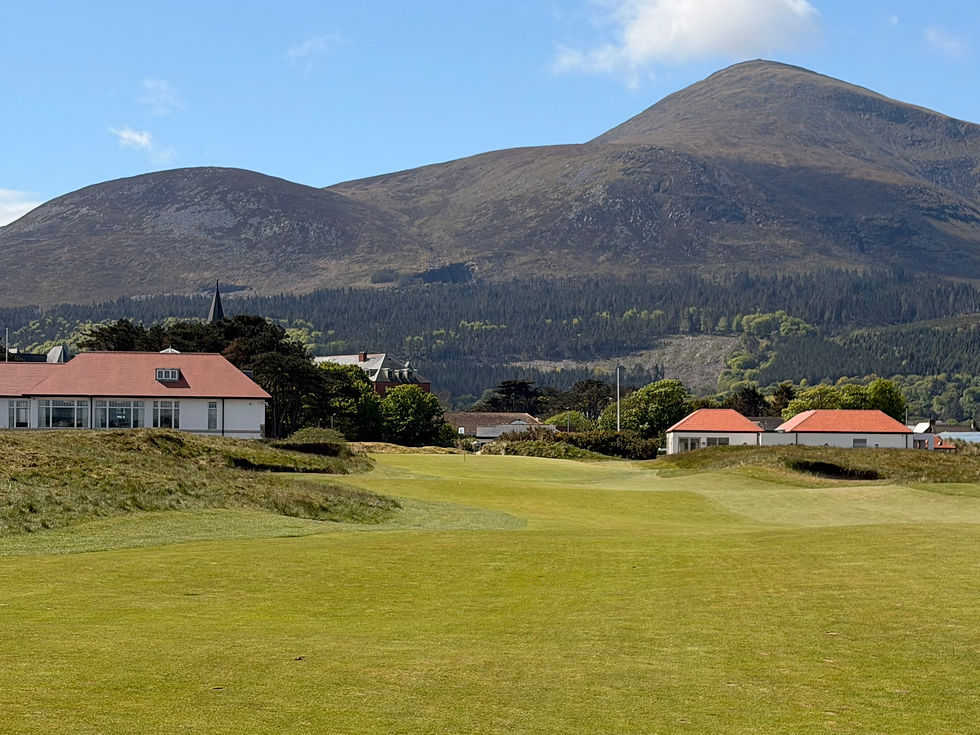
It is an epic finish to a round that I didn’t want to end, played in fabulous company with great caddies.
Thereafter, we had a superb seafood chowder in the fabulous clubhouse which is home to wonderful artefacts, records and photographs from Royal County Down's history.
This day was one of the privileges of my sporting life.


Comments