
County Louth (Baltray)
Updated: Jul 24

“I know exactly where this is going,” I said, as I stared at the deep bunker in front of County Louth’s seventh hole.
Sure enough, I slapped my tee shot and, for the umpteenth time on this trip to Ireland, I could not extricate the ball from its sandy misery.
However, it proved to be the mental spur I needed – because I belatedly got my act together for our big match.

Podcast Partner and I had a wonderful time at Baltray, thanks to the hospitality of County Louth’s captain and vice-captain.
Spoiler alert: we lost our pairs matchplay after 16 holes, but that was not the slightest detraction from a day spent on these magnificent links.
Our day began with a superb breakfast in a stylish clubhouse that has undergone a substantial refurbishment in recent years.

I particularly admired the way the club's history has been fully preserved through the changes and how, despite many international visitors, it remains predominantly a members’ club.
Vice-captain Barrie Breen showed us photographs of his grandmother, Clarrie Reddan, who was Irish amateur champion in 1936 while also making two Curtis Cup appearances in 1938 and 1948.
County Louth, or Baltray as it is locally known, was founded in 1892, but the course we know today was largely defined in 1938 when the club commissioned the renowned golf architect Tom Simpson to redesign the links.

He utilised the natural dunes and terrain of the Boyne estuary to create a par-72 championship layout with intricate green complexes and holes which are cut in different directions, forcing players to account for the wind from every angle.
We had been scheduled to play the previous November, but a storm forced us to postpone until May; thankfully, it was a much calmer day that became progressively warmer.
So, after a few balls on the excellent driving range, we practised a bit of putting and then took to the first.

The par-four first hole has been described as a ‘gentle handshake’ that belies the challenge to come.
However, we were against the wind and three out of our four drives found their way into the rough down the right.
From the outset, the greens are subtly contoured and the fairways seldom offer flat lies. In other words, it is a full-on links experience.

The third is a gem of a par-five, relying entirely on its natural terrain as its defence. Its approach is blind over a large dune ridge before a punchbowl green that falls away alarmingly down to the left. The only route to success is from the right.
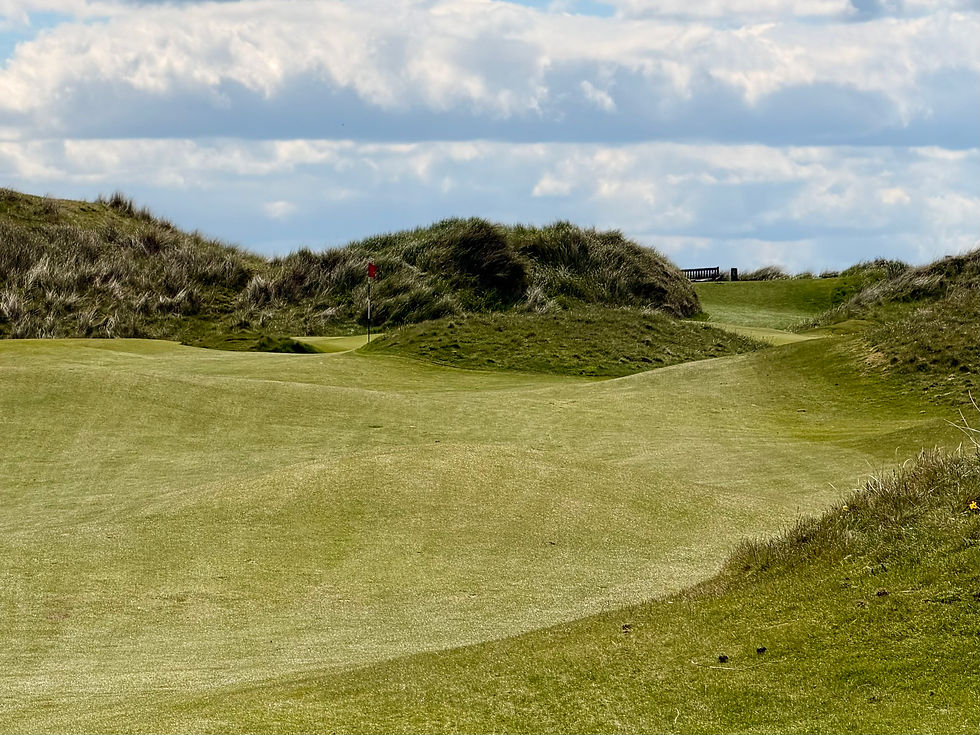
The first par-three is a cracker, playing uphill to a green framed by high dunes, with correct club selection imperative. A short tee shot will find a deep bunker, while one that is too long will see the ball fall down a steep slope.

“That’s been your gentle introduction,” we were told, with the tacit warning that even harder holes were to come for the remainder of the round.
The tenth is my type of hole – a short par-four in front of the clubhouse that bends to a target defended by a sand trap. I missed a birdie putt, but the par was nevertheless the springboard for some distinct improvement in my golf on the back nine.
The 12th is another memorable par-four, with a fairway snaking between the tall dunes. I can vouch how fast the green is, because my lengthy birdie putt zipped well past the cup.
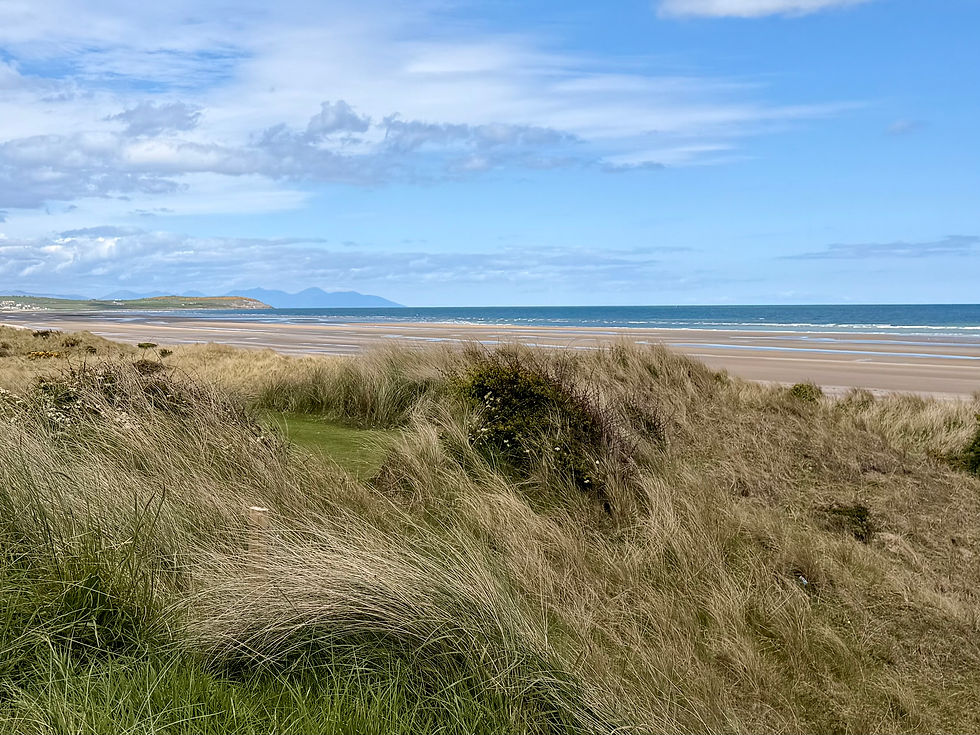
The Irish Sea is over the dunes which border the right-hand side of the 13th, where the undulating fairway leads to another green tucked behind grassed hills.
We walked to the back tee of the 14th for a photocall, with the Mountains of Mourne in the distance and the ocean now to our left. The view matched the drama of the last few holes.
Indeed, I have never seen a hole quite like the par-four 14th, with its dunes down the right before the fairway is interrupted by large patches of rough as it descends towards the green, which sits on a plateau.

I was bamboozled by it, but Podcast Partner, who had been frustrated by his round, completed a rather lovely par.
Hopes that we might make a matchplay comeback were all but extinguished on the par-three 15th, which ascends over a sand trap to a putting surface framed by large dunes.
The 16th could well be the most intimidating drive of the day, with rolling rough down the right of a sharp dogleg that has three bunkers on the corner. Its flag is hidden by a dune and its undulating green falls from left to right.

I was mighty pleased with a par, but it didn’t prevent us shaking hands on a friendly defeat.
The nearest I came to a birdie was on the par-three 17th, which was playing with the breeze. I was advised to play short of the green to avoid bunkers on either side, and followed my pleasing tee shot with a putt which rolled around the cup.

The 18th is a strategic finishing hole towards the clubhouse, featuring a line of cross-bunkers.
It’s a reachable par-five for the long hitter, as Shane Lowry proved during his 2009 Irish Open win, but the thick rough and out-of-bounds on the right keep the tension high until the final putt.
It completes one of the finest rounds in Irish golf.
In more recent years, international tourists have realised the quality of County Louth, so it is certainly not a hidden gem.
Indeed, it has rightfully become an essential element of any East Coast trip.


Comments