
The Island

At the end of the round, the visitor will likely have formed the opinion that the place is literally swarming with hazards of the most formidable character.
"For nature has provided numbers of them in the most unlikely places and of far greater variety than the brain of even a Colt or MacKenzie could devise.”
The brilliance of The Island is that a modern reviewer could use those exact words to describe the links in 2025. However, the above description is from a publication called The Irish Field, dated May 8, 1926.

The framed clipping hangs in the current clubhouse, a structure far beyond the players of that era's imagination. Access to the club was via a rowboat, which ferried them 500 metres from Malahide across the estuary to the first tee (now the 14th).
That was the sole means of reaching the course right up until 1973. Current members still recall the experience, including the peril of a strong tide threatening to carry them away from their round.
The club broke with this great tradition when the boat trips ended, but The Island remains steeped in its history and wonderful Irish bonhomie.

Our enthusiasm for an Irish breakfast prompted us to arrive an hour and a half early for our tee time. Only the maintenance man, Tony, was in the clubhouse, but “no bother” – he immediately made us tea and toast to keep us going while we waited.
This warm welcome was mirrored by everyone we met, from the general manager and the long-serving professional to the greens superintendent, the lunchtime waitress, and the members on the course. Their good humour felt genuine and not forced by a corporate away day.

I can’t blame them for being so happy. I only spent four hours playing golf at The Island, and I could easily imagine that being here daily must be a joy.
While these are traditional links, the club is constantly refining the course and maintaining its playability. To this end, Martin Ebert and his team have been working to improve tee boxes, run-offs, and other elements.
Consequently, the first hole and the second tee were out of commission on the day my Podcast Partner and I played.

We did, however, walk the opener, whose tee stands in front of the clubhouse next to a fabulous sculpture of three men in a boat. It is a par-four framed by furry dunes that funnel towards a raised green.
Our comedic moment came as we tried to walk past it to the second and found our way blocked by a bulldozer. The greens staff must have laughed as we struggled to carry our bags and trolleys to safety after getting stuck on a muddy path.
We were, thankfully, able to play approaches to the second, which features a rippled fairway leading to a two-tier green defended by pot bunkers.

Although The Island does not have a vast number of sand traps, the best advice is to take an extra club to avoid them, as well as the many false fronts.
I learned this lesson on the third, a relatively short par-five into a green perched above a dramatic fall-off on the right. My approach was a few feet short, took the bank, and rolled 20 yards away.
My Podcast Partner notched a par and followed it with another on the juicy par-three fourth, which again demands a full, committed strike to avoid the sand. Unfortunately, a gust of wind blew my ball off the green to the right.

My best run of the day came from the fifth to the ninth – a gorgeous section where dunes beautifully separate the holes. The fifth is a long par-four.
I drove down the left and hit my second from one of a handful of areas where winter mats were being used to protect the fairway turf. I struck a five-iron to about 15 feet, missing the birdie but happily accepting a par.
The sixth is one of the most memorable golf holes in Ireland, with its blind tee shot into a valley shaped by the most exaggerated undulations I have ever seen.
My approach from the left-hand side of the back-to-front sloping green was pleasing enough to earn a par.

The seventh is one of The Island’s quirkiest holes, as its target is tucked on a sharp left bend around a dune. PP’s ball slipped down a sharp left-side run-off, but his impressive up-and-down earned him a par.
Probably my best effort of the day was on the ninth – a tough par-four straight into the teeth of the wind.
Thankfully, my drive just avoided heavy rough down the right and was followed by a 200-yard three-wood ‘stinger’ that flew the green. However, I managed a chest-high chip, followed by a 12-foot putt for a hard-earned par.

Could The Island’s back nine match the front? Absolutely.
The quality of the fairway and green turf was superb, and players who manage to stay on the short grass will be rewarded. However, those who wander off line are likely to lose balls or face some interesting lies in the dunes.
Playing left on the par-five tenth, named 'Quarry,' and avoiding the grassy chasm on the right is imperative for a good score.

The sea and the town provide a gorgeous backdrop for the stroke-index one 12th, known as 'Valhalla.' A large dune on the left of the green awaits those who are awry or over-ambitious with their approach.
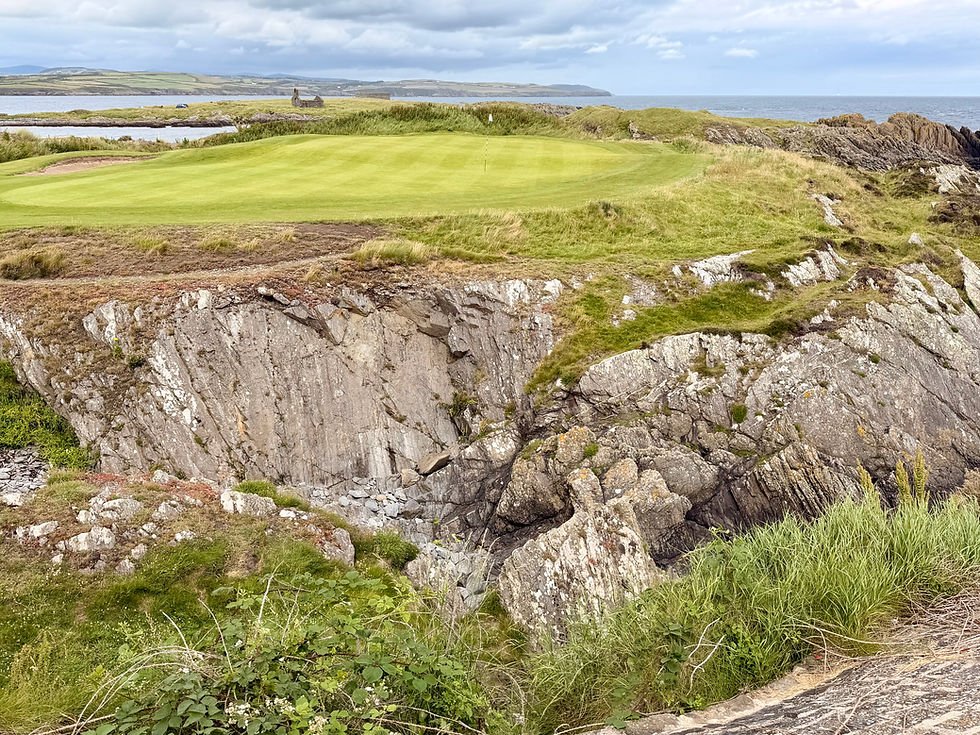
This is followed by one of the great par-threes, with inspirational views as its backdrop and waves lapping onto the rocks on its right.
The flag at the rear of the green was 220 yards into the wind from the tee, so I took a driver to avoid the grassed bunker in front of the target. Alas, my ball flew through the green by two yards, and I had to be satisfied with a bogey.

I thought I would do better on the signature 14th after our drives landed safely on what the team claimed was the narrowest fairway in the world.
PP notched a lovely chip to about 12 feet. I was clumsy with my approach, which dropped short, and went on to miss an easy par putt, while he just missed out on a birdie.
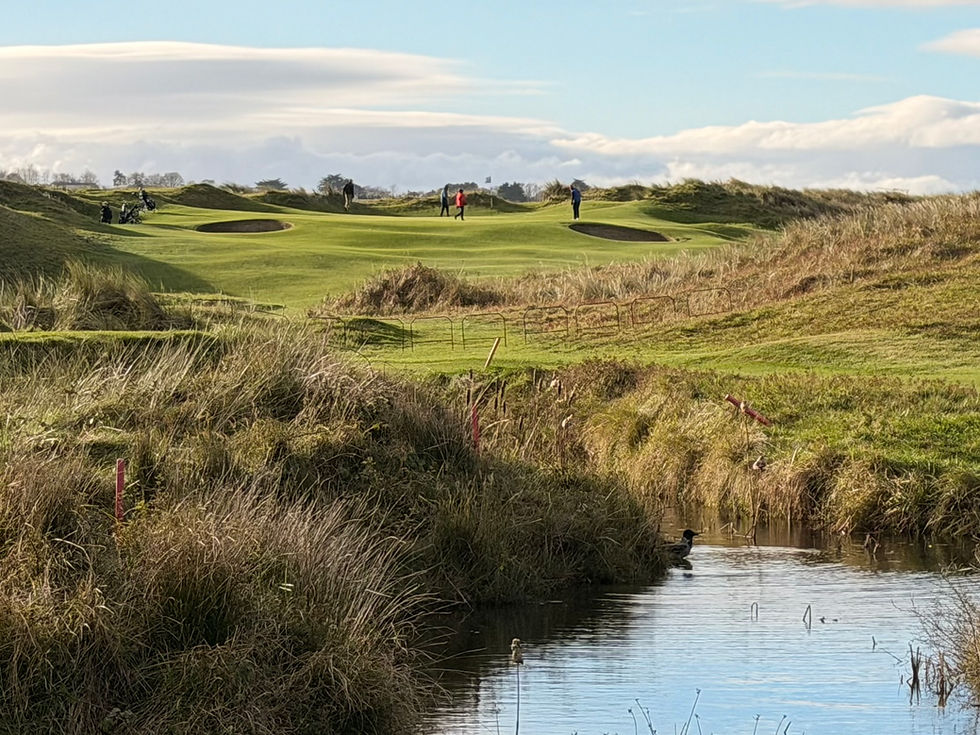
Of all the holes at The Island, the 15th is the one I would most like to play again. This par-five is straightforward from the tee, but the second shot is blind over a dune into a rippled fairway flanked by more hillocks.
If that can be safely negotiated, the approach is to a green tucked away beneath dunes and beyond a bunker to the left.
The 16th is the final par-three and again demands accurate club selection. I can attest that those who don’t club up enough will find one of the pot bunkers.

“You can play as long as you don’t hit us,” exclaimed the two lads working on the path on the 18th.
We had been given special dispensation to play on a course that was closed during its upgrade, and I was thrilled to drill a drive straight down the middle.
This is a wonderful closing hole at more than 450 yards against the wind. I hit my three-wood as hard as I could with my second shot, but it was still 120 yards short and frustratingly found a pin-high pot bunker.

The great thing about the sand traps at The Island is that they give the player a fighting chance, as they don’t have overhangs that force vertical shots. I swished out to a couple of feet for a tap-in finale to a round that left us buzzing.
We were delighted to confirm that The Island is rightly regarded as one of Ireland’s premium links.
And the lunchtime burger in pepper sauce ain’t half bad either.


Comments