
Portmarnock

“Be up” is the motto of glorious Portmarnock.
I would have done well to pay heed because time and time again, my shots fell short into its notorious bunkers
But before a player even steps onto the highly acclaimed championship links, they experience the very best in on-point service.

This includes a meal in the superb, traditional clubhouse as part of the price.
We were late-morning arrivals, so we indulged in a delicious breakfast (smoked salmon and scrambled eggs for me), presented with panache.
In the corridors and the dining room is a wealth of framed nods to the club’s illustrious past.

The club was established on the Portmarnock peninsula, a strip of land that hugs the famous five-mile beach known as "The Velvet Strand."
The primary founder was Scottish insurance broker William Pickeman, who rowed a boat across the Baldoyle Estuary with his friend George Ross from Sutton to explore the peninsula, which at the time was occupied by tenant farmers.
The course originally opened as a nine-hole layout in late 1894 and was quickly expanded to 18 holes by 1896.

Six-time Open champion Harry Vardon suggested improvements to the bunkering and green complexes in the early 1900s.
It has been a central pillar of Irish competitive golf for over a century, hosting the Irish Open 19 times.
More recently, it has been hotly tipped to be the first club in the Republic of Ireland to host The Open.
I digress.
Following breakfast, we drove to the impressive driving range where free balls are available.
My costly mistake was not practising my short game; by the tenth, I had been in eight bunkers on seven separate holes.
We had been scheduled to play with two other visitors, but mysteriously they failed to emerge.

So, Podcast Partner (PP) and I were sent out on our own, taking our time behind a fourball because there was nobody behind us.
The jovial starter told us that we would be sent a video and photos of us on the 1st and 15th as part of the package.
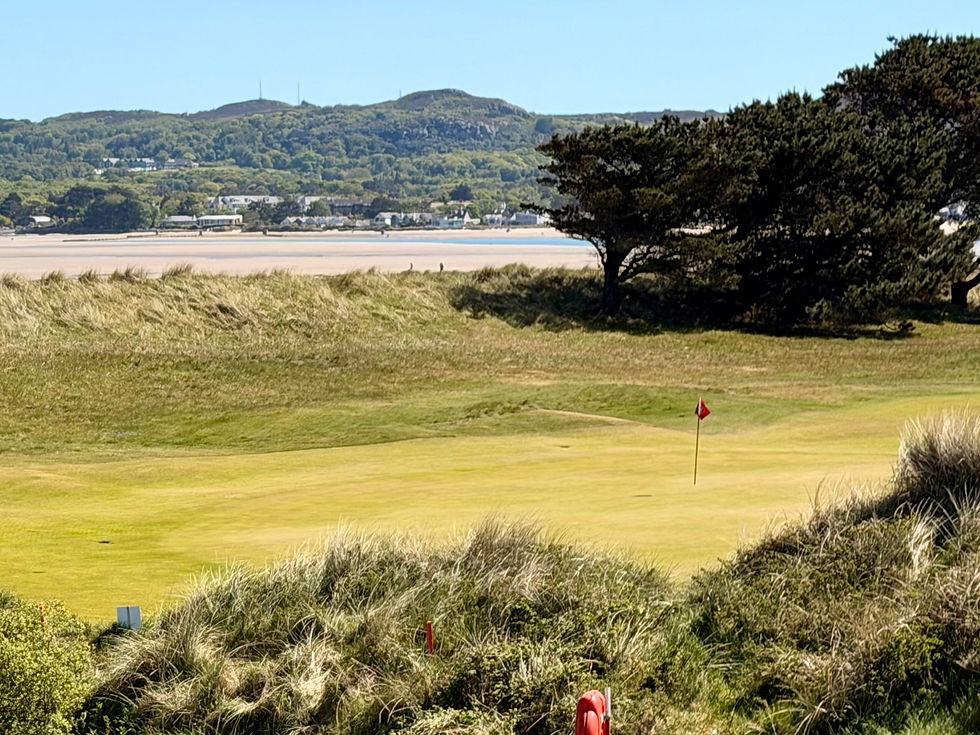
He also advised us where to drive our ball down the first—a par-four running parallel to the sea with a trio of bunkers down the left.
The tone was set for my day when my ball fizzed into the first of those deep traps. The only way out was sideways, and I then unwound a three-wood only to career the ball into the face of the third bunker.
It was so deeply plugged, it was hard to see. PP struck down the right and advanced to the centre of the green before completing a straightforward par.
My bunker mire abated for a moment on the fourth hole, a stunning par-four, stroke index one.

Shots down the left will be blocked out from the green by grassy dunes, while sand traps await those who aim at three groups of trees down the right.
The green moves quickly from front to back, and the over-adventurous will find themselves in dense rough behind the hole or, worse, a hidden pond.
The glorious views from the elevated fifth tee look across to the bay on the left, while the drive is blind over two humps. The tip is to steer left over the white stone for a straightforward approach.

I can attest that a strong hit down the right will find another bunker with a vertical riveted face.
The longest hole on the course is the sixth, with bunkers lurking down the left and right before it turns between dunes and past a pond on the left.
The green has a false front and a sharp run-off to the left, so the job isn’t complete until the ball is in the cup.

It should be said that the condition of Portmarnock is exemplary. The fairway turf is true, and the putting surfaces are wonderfully consistent.
I was struggling to score but was pleased with a central drive on the par-four ninth that curves back towards the clubhouse.
My ambitious second shot was well struck but drifted away from the elevated green into a greenside bunker. The perceived lack of justice scrambled my mind, and I failed to extricate the ball.

Comedy came on the wonderful par-three 12th, redesigned by Martin Hawtree in the early 2000s.
It is only about 160 yards, but its green is cunningly set above a bank so steep that PP saw his stinger reach the green and slip back down to the side of a nasty deep bunker.
He decided he wanted another go and went more aerial, but the result was exactly the same.

The 14th begins a five-hole run-in that legendary writer Bernard Darwin described by saying, “I know of no greater finish in the world.”
It is a dogleg left and, having finally learned my lesson, I played up short of the menacing sand traps to leave a simple pitch into a perched green to earn two points.
Incredibly, Irish amateur legend Joe Carr famously once made a hole-in-one here on this 385-yard par-four.

Another jovial chap met us on the tee of the 15th—the most iconic hole at Portmarnock.
He took our email addresses to send the promised footage of the 1st and 15th, combined with drone shots of the course.
It was akin to a horror film as far as I was concerned.

The par-three plays entirely along the shoreline of the beautiful beach where families were playing. The green is long and narrow, defended by three brutal bunkers. Inevitably I found one—with my second shot after hooking my first.
I made a better fist of the 16th, despite its ridge of cross-bunkers on the fairway and pot bunkers near the target.
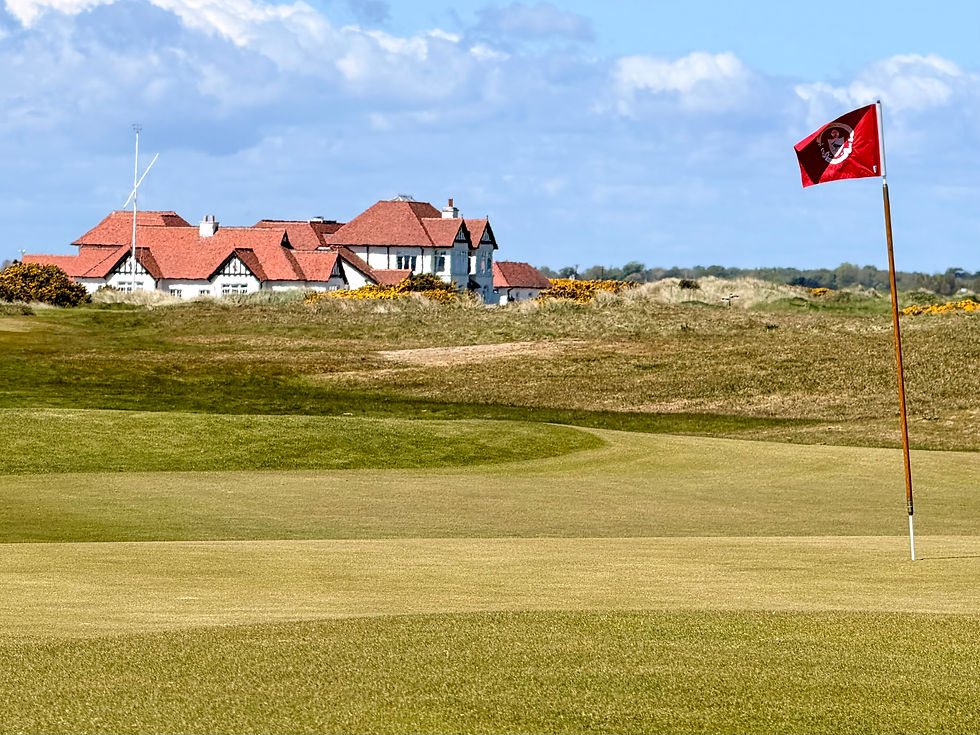
The finishing hole is a classic, leading back towards the famous clubhouse.

It requires a long, straight drive to avoid the heavy rough and a precise approach to a green that has seen some of the most dramatic moments in Irish Open history.
Portmarnock is a truly world-class golfing experience.
I just wish I had avoided its fiendish bunkers—or at least had a lesson on how to get my ball out of them.


Comments