
Castletown
Six years ago, I dreamed of standing on the final green of my 100th GB and Ireland top-100 course.
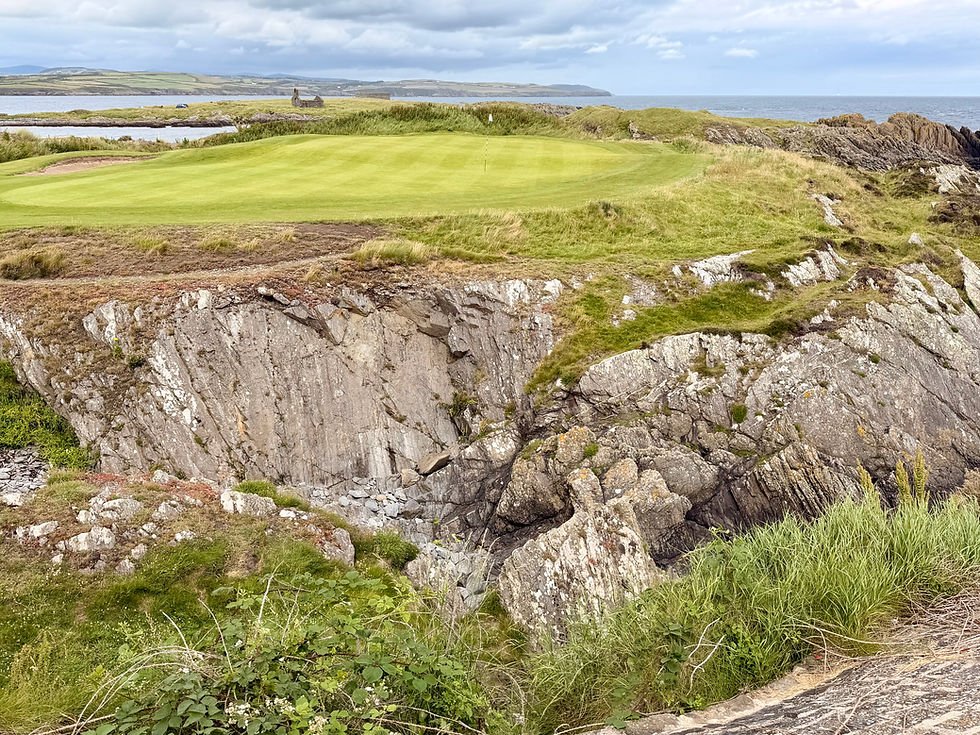
And nowhere could the backdrop have been more dramatic than at the 18th at Castletown on the Isle of Man.

Rare unpreparedness meant that an imperfect second shot had cleared a ravine by a single yard. I hadn’t even known that this rocky golf ball graveyard was there.
I certainly did during my second round, but knowledge wasn’t power; this time, my ball went down the cliff.
Castletown is proud of its pedigree: Old Tom Morris laid out the original links, Alister MacKenzie made improvements 20 years later, and Philip Mackenzie Ross updated it after the Second World War.

It is a visual delight. Situated on a peninsula, the Irish Sea is visible from every hole and comes into play on several of them.
The clubhouse is modern and a lovely spot for breakfast, as Mrs W and I can attest, having eaten there on three consecutive days.
Demolition work was under way at the neighbouring derelict hotel. The owners plan to turn it into a boutique hotel and spa facility to complement further upgrades to the course.

Out on the links, the 1st looks so straightforward, yet despite being in decent form, I messed it up on consecutive days. It is a short, uphill par four with a big bunker
protecting a sloping green.
On day one, I struck my approach too aggressively, and the ball disappeared into thick heavy cover behind the target.
Fortunately, my head did not wobble, and I found my game at the 2nd – a long par four flanked by wispy fescue, featuring a fiendish double-tiered green squeezed between bunkers.

The first par five was so tricky in the fierce left-to-right wind on day one that drives were blown straight into the straw-type rough on the right.
The fairway turns left towards a green set in a dip beyond bunkers and thick grass. Once again, being overly aggressive risks serious trouble beyond the putting surface.
I loved the short par-four 4th, which is made for a draw off the tee before presenting a conundrum: how best to attack a sloping green cut inside deep rough and nasty-looking bunkers?

And then comes the famous 5th, running alongside the main entrance road.
On our arrival, we had remarked how tight it was, with its narrow fairway bending round to a green directly next to the tarmac. From the tee, it was even more intimidating.
Drives must carry dense cover, avoiding the entrance wall to the links, the thick vegetation to the left, the road, and even the beach beyond it.

The beach is now in play, having been out of bounds until a couple of years ago. Our playing partner found his ball down there and played out handsomely.
I was happy to avoid all the obstacles, recording a bogey and two points on both days.
Overall, I scored much better during our second round, avoiding many of the pitfalls of day one on a gentler afternoon.

This included a comfortable par on the par-five 7th, which is played over a section of the 17th-century Manx Derby racecourse.
A more modern form of transport is apparent nowadays, as the hole sits adjacent to Ronaldsway Airport – where my ball from day one currently resides.

The first of Castletown’s par threes is the 8th: a fiendish short hole over rough onto a green flanked by a dune to its left, with a public footpath and the sea to the right. Precision is the name of the game here.
The bay remains on the right of the 11th, with plenty of wispy heather down the left of a long, testing par four.

During our visit, respite came on the 12th – a downwind par five that offered scoring opportunities if the fairway and greenside bunkers could be avoided, and the ball kept clear of the thick stuff on the right.
On our first day, our playing partner nestled in a long putt for a satisfying birdie, and I was determined to match him on my second attempt.
However, despite reaching the edge of the green in two, I could only manage a par, defeated by the subtle contours of the putting surface.

I loved the 13th – a gorgeous par three of only 118 yards, featuring a huge, swirling green perched above a treacherous trap. It feels like a prime chance to score, but it can certainly bite back.
I could easily describe every hole at Castletown because they all have commendable characteristics, but the final three really stand out.

The 16th is a belting short hole with bunkers on either side of a green that slopes off from left to right. I was chuffed with a three here.
That serves as an appetiser for the 17th – a par four played straight over a ravine. Even those who cross the abyss face the danger of losing balls in the bushes down the right, dropping into fairway bunkers, or bailing out too far into the rough on the left.

The famous commentator Henry Longhurst acclaimed it as one of his favourites in the world, and I could easily see why.
Then there is the 18th, which demands an uphill drive to a ridge with trouble on either side. You are then faced with what seems like an innocuous knock onto the green, framed by a 12th-century chapel and 16th-century fort as the backdrop.

However, hidden from view is a gorge separating the fairway from the target – a graveyard for any short approach.
It is as dramatic a home hole as I have ever played and provided the perfect finale to my top-100 GB & Ireland quest.
It’s a shame I played it so badly twice, but that just means I will have to return to Castletown. Which, frankly, would be a absolute pleasure.


Comments