
Te Arai (North)

“You’ll need a bucket and spade for that one.”
Our genial host had a glint in his eye as he watched us fall for the perils of Tom Doak’s quirky classic: Te Arai’s North Course.
“Classic?” I hear folk ask. “Can a course only two years old be so highly acclaimed?”

The answer is a resounding “yes”. If accommodation weren’t still being built around the perimeter, it would be easy to believe it had been there for decades.
The turf is astoundingly tight and consistent across the tees, fairways, and greens—the latter being some of the most treacherous I have ever encountered.

We were shuttled by minibus to the North Course from the main reception, having enjoyed an excellent breakfast at Ric’s, one of the club’s restaurants.
This is a five-star resort with service to match, yet it maintains a wonderfully relaxed atmosphere. Staff whisked our bags to the impressive driving range next to the pro shop before picking them up for the short journey to the first tee.

The North and South courses alternate between member and public play.
Because we were playing with an Australian member who has been at Te Arai since its opening, we were on the quieter of the two.
Indeed, there were so few people on the course that we were joined by two Americans we had met the previous evening.
We hadn’t played in a five-ball before, and while it wouldn't have been permitted if we had interrupted play, the gesture emphasised Te Arai’s easygoing style and was great fun.

The opening holes are reminiscent of Tara Iti, with ocean views and sandy wastes framing the fairways.
The first is a gentle opener—a par-four with a pronounced left-to-right slope. I struck my drive so heartily that I was able to putt my second shot to about 15 feet.
Unfortunately, there was no birdie for me and it was my first indication of the questions these greens pose.

This particular surface is two-tiered and uphill; coming from a sluggish UK mid-winter to such consistently speedy surfaces was mind-bending.
Understanding angles is essential on the par-three second, where a shot down the left will trundle towards the target. Unfortunately, mine caught a dip, and my long birdie putt skimmed the hole before racing eight feet past. That story was repeated often.
My round began to unravel on the fourth—a mesmerising par-four with what our host described as a "beach" down the right-hand side.

It accounted for my first "blob" of the day, while Mrs W rescued points with an incredible five-wood strike from the sand onto the wildly undulating green.
My only lost ball followed on the fifth, pulled into native bushes bordering a par-four framed by sand.
The upside-down saddle green on the sixth is among Doak’s most enthralling designs. Those in the know play firmly past the hole to watch the ball return towards the cup.

The par-three seventh features another rippled green with the flag hidden in a bowl behind a deep trap. I thought I had hit the perfect draw, only to find the sand.
On the face of it, the par-five ninth offers a major scoring opportunity, with a wide-open fairway leading over a ridge to a sharp fall. Long hitters can reach in two, and even middle-handicappers like me should be there in three. However, I was punished for being overly aggressive; my approach hit a downslope and flew over the back.
It was a sweltering day, so a cold Te Arai Lager at the impressive halfway house was gratefully gulped down. The devil is in the details here: even the empty cans are deposited in discreet, below-ground bins.

Distracting signage is avoided, the routing is intuitive, and only tee markers are flush with the ground. Conversely, there are more yardage markers (at ground level) here than on any course I have played—unobtrusive but incredibly helpful.
Rash choices were to blame for my poor mid-round scoring. On the par-five 11th, I struck a decent tee shot but tried to carry the huge bunkers with my second. Inevitably, I found the sand. I should have played short of the ascent to the green atop the steep bank.
I adored the North Course, but I confess the greens had me bamboozled all day. Nowhere was this truer than on the 13th, a long, bending par-four with the pin tucked high on the right.

I tried to guide a three-wood to the middle of the green, where a bird sat nonchalantly. I swear it didn't move as my ball raced towards it; it knew the contours would sweep the ball down the bank to the left.
My subsequent putt failed to reach the crest of the hill and funnelled back down. The humiliation continued until I finally carded a seven.

Just as I began to believe I wasn’t up to the challenge, I managed a stellar finish. This started on the par-three 15th, which features another treacherous green falling alarmingly from back to front.
My tee shot fell short of the deep greenside bunker, and somehow my chip stuck on a downslope, allowing me to save par. This was followed by a birdie chance on the 16th, which drops steeply before rising so sharply that the approach is blind. My shot of the day left me a ten-footer, which I narrowly missed.

Another opportunity arrived on the 17th, a jaw-dropping par-three with an ocean backdrop. Even our host thought Mrs W and I had struck our shots too far right, but both balls caught a bank that fed them toward the hole.
The 18th is a mesmerising dogleg par-five, played below some of Te Arai’s premium properties. The fairway rises and falls like a rollercoaster, flanked by sandy waste and scrub.
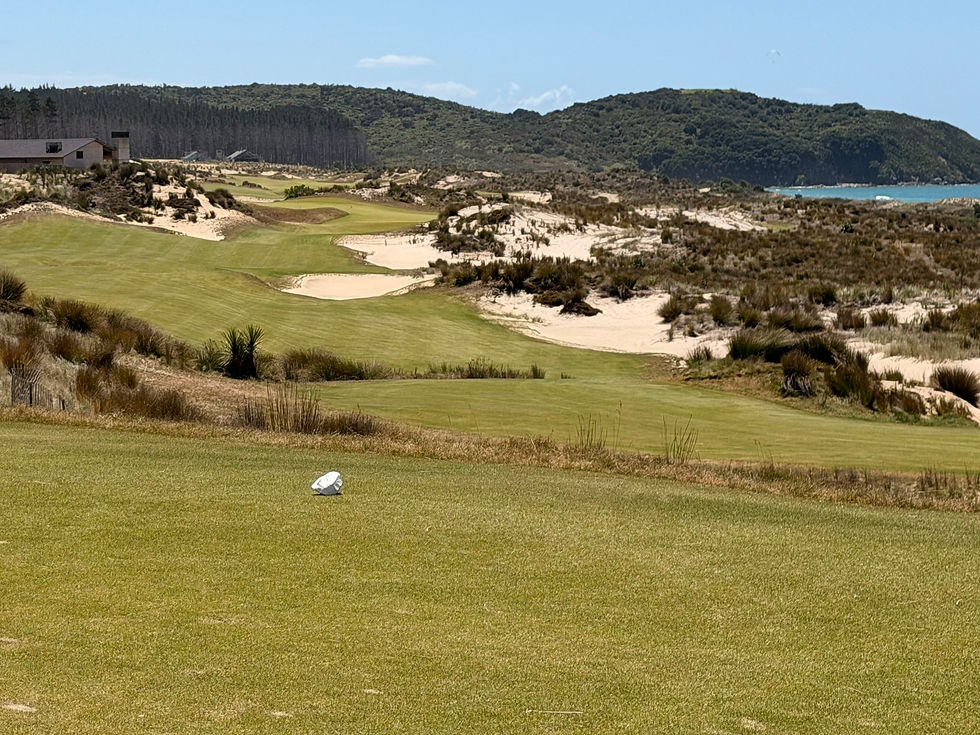
Our host had been such good company all day that it was a treat to see him thin his approach and watch it trundle to within three feet of the flag. Champagne moments come in many guises, and it was a delight to see one on the final hole.
My topsy-turvy scoring certainly didn't dampen my appreciation for this quirky masterpiece, which is destined to soar in the world rankings.


Comments