
Palmares

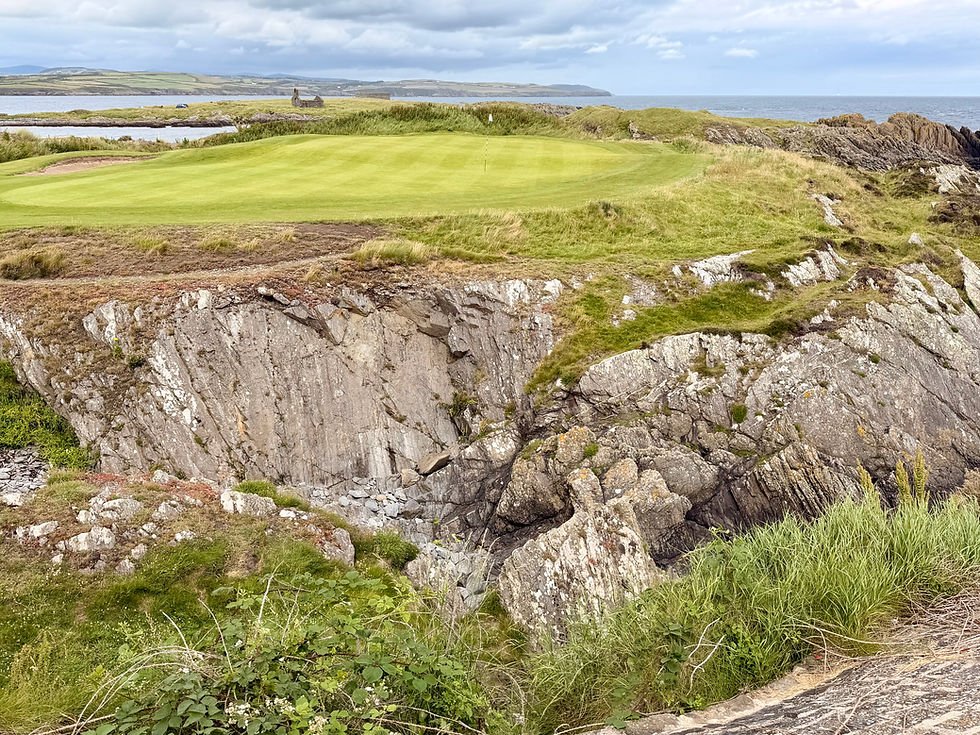
“This is like a slice of Scotland has been dropped on the Algarve coast.”
My surprise at the nine-hole Praia loop at Palmares was heightened by the fact that it was designed by Robert Trent Jones Jr.
I always think of Jones as a master of inland courses featuring fabulous water hazards and giant white bunkers.
But Praia is a much more rugged nine that cleverly uses the natural landscape. I felt so much at home that I ran in five consecutive pars, despite previously showing no such form.

Palmares has 27 holes, divided into three very different nines. As we didn’t have the chance to play them all, we settled on the Lagos/Praia set-up.
The former has some sea views but a more Mediterranean feel, with several holes easily identifiable as the designer’s signature style.
These comprise the club’s holes 10 to 18, followed by the Praia loop, holes 19 to 27. We didn’t have time to play the Alvor holes, which are numbered one to nine.

We had breakfast on the balcony of the gorgeous clubhouse—a striking, modern structure designed by Pritzker Prize-winners RCR Arquitectes—overlooking a new hotel development and, further down, the course and the sea.
Thereafter, we took to the practice green, which intimidates with its severe slopes and speeds.
The variety of the Lagos/Praia set-up is intoxicating; it is one of the few layouts I have played with an even split of six par threes, six par fours, and six par fives.

The opener on the Lagos is a peach, demanding a downhill drive between trees before the fairway turns towards a perched green that falls from left to right towards a menacing bunker.
The par-three 12th is the first ‘knee-knocker’, with a lake guarding the left and front, forcing the player to the right. Its green is especially slippery.

I don’t recall playing a longer par three from the gold tees than the 14th, which my Garmin measured at 224 yards. Into the Atlantic wind—which defines the challenge here—I took driver and was still short.
It is followed by a big opportunity on a par five that rises before dropping sharply. The tee shot needs to avoid the trees and bushes on the right, and the approach may make the heart flutter due to the camber towards a lake on the left.

There is a stunning sea view from the tee on the par-five 17th (our eighth), where any misplaced drives will find grisly rough amid bunkers on the right.
Our tenth hole was number 19 on the property and the first on the Praia course—arguably the most ‘linksy’ routing in Portugal.
It begins with a glorious downhill dogleg par four, with spindly trees awaiting those who try to cut the corner.

A tunnel under a railway track leads to four holes that hug the coastline and genuinely evoke the spirit of East Lothian.
The par-five 20th has scrub and bunkers on either side of a fairway that winds into a tight entrance to the green.

My game was decent but lacked real spark until the 22nd—a long, daunting par five with a huge bunker down the left.
Second shots can be gobbled up by a grassy knoll in the middle of the fairway before approaching a perched green. I was thrilled to have a tap-in par.

This heralded a run of pars across two par threes and two par fours, though alas, there were no birdies and, therefore, no champagne moments.
The final hole is a worthy climax: a par-five dogleg left, playing up the hill towards the clubhouse. I unfortunately found a greenside sand trap, but no matter.

We had been beguiled by the variety at Palmares.
And the culinary experience at restaurant Al Sud is a high-end match for the golf.


Comments