
Old Head

I have played more than 200 of the most acclaimed golf courses in the world, including the much-lauded cliff-top course at Cape Kidnappers in New Zealand, but none have been more spectacular than Old Head
I only wish the weather during our visit had been more benign.

Unfortunately, the wind blew so strongly that decent scoring became fiendishly difficult; the more I tried to save my card, the more frustrated I became.
However, I can understand why many international members return year after year.

From the moment a player drives past the gate—and the Stars & Stripes alongside the Irish Tricolour—there is an American feel to Old Head.
The clubhouse is immaculate, the service from the caddy master and starter is five-star, and the practice facilities are exemplary.
There is also a sense of, “How the hell did they carve a golf course here?”

A castle has stood on the headland since at least the 3rd century, with the ruined iteration featured in the course built in 1223.
While an early lighthouse was established in the 17th century, the current one is visible from almost every shot. It is less than 12 miles from the point at sea where the Lusitania was sunk in 1915.
Old Head was the brainchild of brothers John and Patrick O’Connor, who bought the land on a whim in 1989 and envisioned an exclusive, world-class golf destination.
Their dream team of six designers included Eddie Hackett and Ron Kirby, and construction took nearly ten years. The result is what some observers have dubbed a "Disneyland for golfers."

Every hole is a photographer’s dream, often carved right beside cliffs that lead to an Atlantic abyss.
On a good day, finding the targets demands precision; when the wind blows, the challenge is more than formidable.
We were teamed up with a jovial Australian and his New Zealander father-in-law for our early morning round, and they were great fun throughout.
After a gentle opener, the first "wow" moment arrives at the spectacular par-four second.
This is a sharp dogleg cut around the cliff, where the fairway looks like a mere sliver from the tee.
The green is so tight to the edge that any ball left or long will be in the sea, while anything too far right finds thick tropical vegetation.
I found the latter—which included palm trees on some stretches—a little strange for Ireland. Perhaps it is intended to make the Americans feel even more at home.

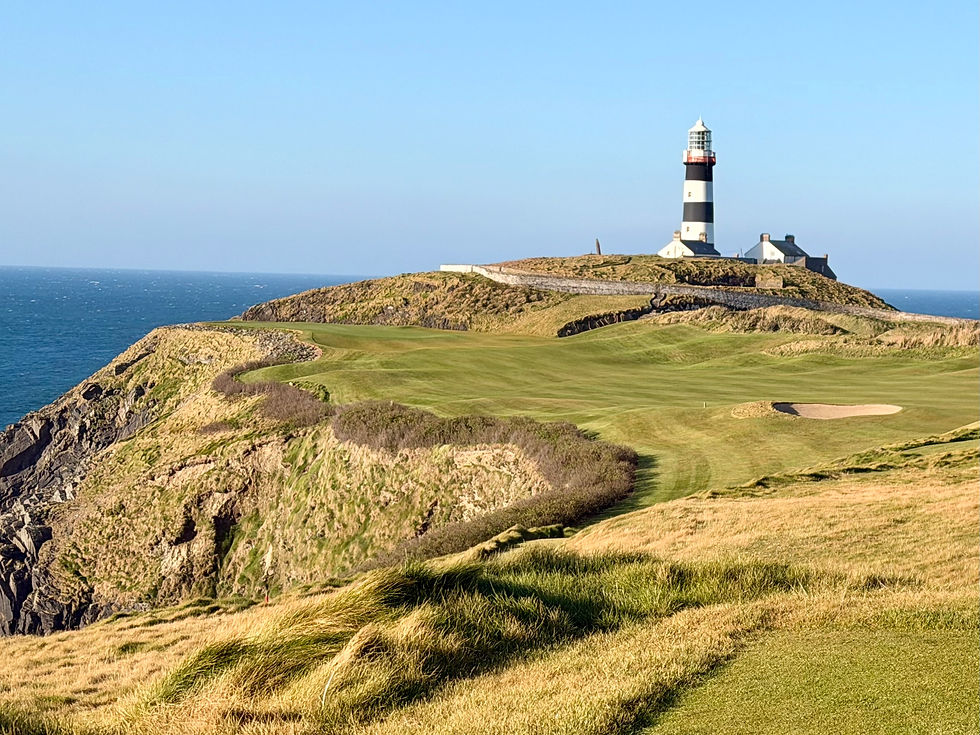
The fourth is played directly towards the working lighthouse and should have been doable after a decent drive, even in strong winds.
However, I under-clubbed because I thought my Podcast Partner and the Aussie had hit past the target and down the cliff.
In fact, their pin-high balls had been concealed by a lip on the green, which is guarded by an old stone wall down the right. They nailed pars, and I double-bogeyed.

Indeed, I struggled all day to find the pace of the greens, which were unusually slick for a course so close to the ocean.
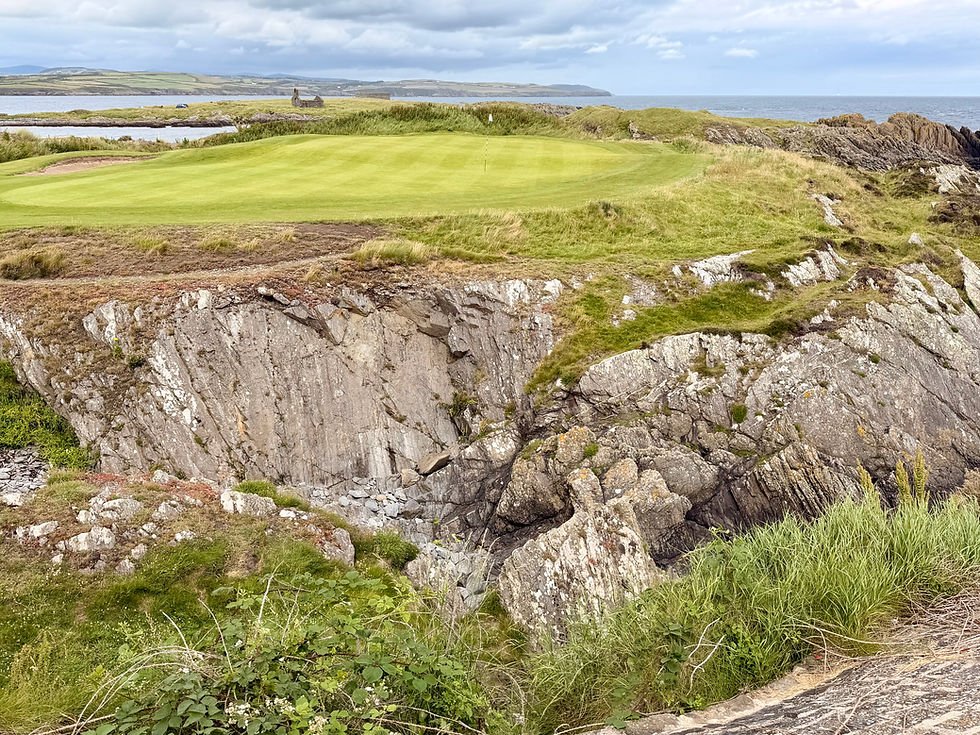
After a stunning par-five towards a perched green next to one of the many ruins, comes a par-three with an abyss on the right and a steep bank on the left. It is yet another short hole where the wind befuddles club selection.

Much-needed shelter and half-time refreshment came in the form of tasty sausage rolls, hot dogs, and coffee, served with a smile.
Then it was on to a back nine that holds even more drama than the front. The penalty area on the tenth is an ancient burial ground around which the par-five is played.
This time I didn’t club down enough; the prevailing gale blew my ball beyond a green I should have comfortably made in regulation.

The par-five 12th is sometimes referred to as the most intimidating hole in golf—with good reason. Its tee box sits on a small platform, 300 feet above the sea.
All that can be seen of the fairway is in the far distance, leading to a green that appears as a mere dot on the landscape.
The drive must be hit right over a stone marker against the wind. Failure to make it results in the ball plugging in the grass cliff or, worse, falling into the brine.
Mine looked good but succumbed to the breeze. I had to scramble down about 20 feet to try and play it from under my feet, with the constant fear of tipping down the bank.

My first shot went into a rabbit hole, but I emerged unscathed thereafter and somehow ended up with a seven on the precipice green and a Stableford point.
The wind was buffeting so badly that it took at least three minutes just to keep the ball on the tee before playing into the very exposed par-three 13th.
I thought my five-iron was surprisingly decent, but it drifted right of the target and the ball was never seen again. Indeed, only one of the four of us completed the hole.

There is no let-up on the final holes, beginning with the short par-four 15th, which ascends over a ridge before dropping steeply from left to right.
Wayward shots will find the sea. I succeeded there but did not on the cliffside, par-three 16th, where we were using drivers for a 150-yard hole.
Tee shots had to be aimed 30 yards left to accommodate the wind; my straight hit found the brine without touching the sides. My follow-up was even wider.

The 17th is startling, demanding a centre-left blind drive to avoid the rocks that run the entire right side.
The fairway then narrows towards a green tucked into a natural punchbowl on the edge of the headland.
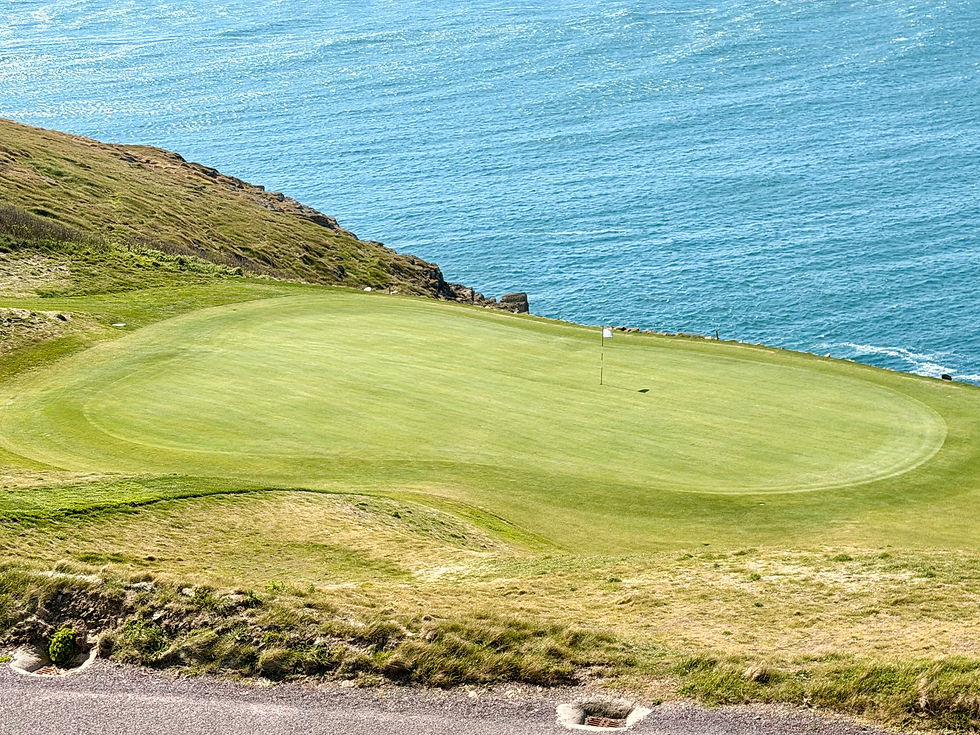
I had long since dispensed with my scorecard and shaken hands on the matchplay with my Podcast Partner when I heaved my drive into prickly bushes beyond the bunkers on the left of the curving home hole.
PP emerged with great credit, nailing his approach into a partially hidden green to secure a par.

But the chap who deserved the most praise was the 80-year-old New Zealander.
He rightly chose the yellow tees and proceeded to keep the ball under the wind for the entire round.
Consequently, he scored more pars than PP and me combined.
Despite our travails, Old Head was an unforgettable experience—and one I would not have missed.


Comments