
County Sligo
- Neil White
- Sep 24, 2025
- 4 min read
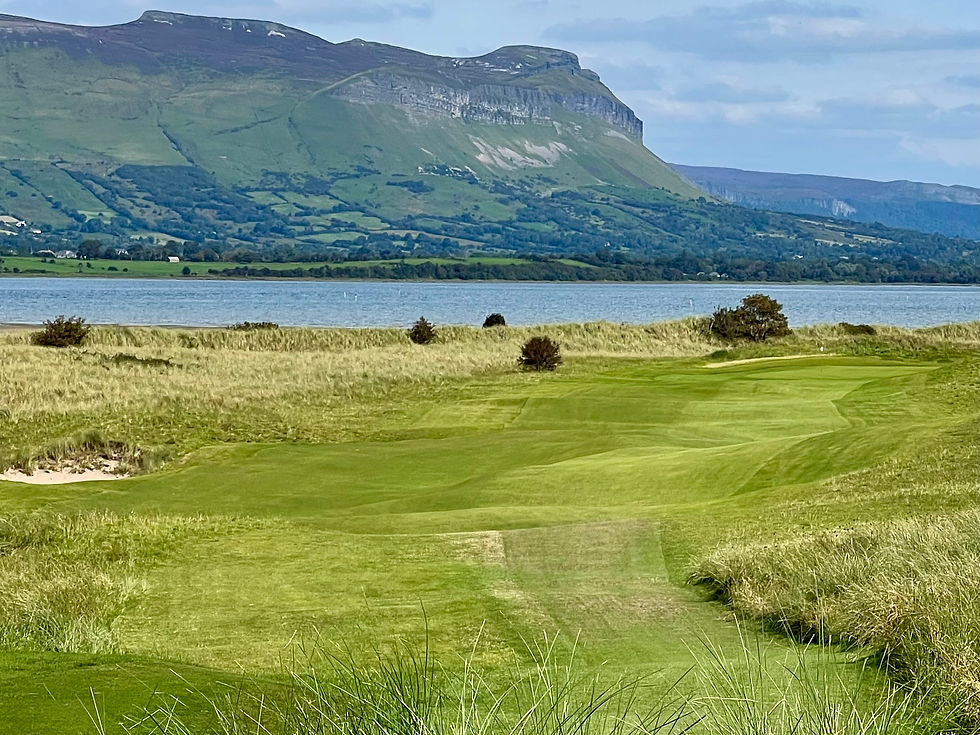
As we stood looking down on the fifth fairway and across the bay beyond, we could understand why this was "The Land of Heart's Desire."
One of Ireland's most famous sons, W.B. Yeats, used these words to describe County Sligo's romantic landscape.
Indeed, the sight of the flat-topped mountain of Benbulben, the backdrop to several holes, inspired his Nobel Prize-winning poetry.

The welcome at Sligo is as friendly as anywhere in golf, and the clubhouse offers modern services while nodding to the club’s illustrious past.
The club dates back to 1894, when it was founded with six holes. By 1907, a full 18 were in play, but the most significant change came in 1927, when Harry Colt was hired to redesign the course.
Colt's work at County Sligo, known to locals at Rosses Point, is considered one of his four most outstanding achievements, alongside Wentworth and Sunningdale's New Course.
It has many Colt trademarks, especially its intense bunkering.

During our round, we experienced a blend of the old and the new because we were joined by two delightful young American scratch players, social media influencers with enormous followings.
However, even their powerful hitting could not always overcome a course that demands as much brain as brawn.
The first hole is a gentle introduction—an uphill par-four over a road with bunkers on either side of a rippled fairway leading to a green with a false front.

The second provides a greater insight into the drama to follow. Those who slice or fade to the right could see balls fly over a boundary wall that juts out towards a fairway that rises steeply to a hidden green.
Even those who miss the pot bunkers protecting the target may be frustrated by sharp run-offs, a regular feature at County Sligo.
Mackenzie & Ebert have completed a renovation programme, including creating a new green on the third hole, 65 yards from the previous one. This adds length to a compelling par-five which meanders downhill between two bunkers before dropping through rough to a flatter section.

The course moves nearer to the sea on the fourth, which is called Gan Gaineamh (Gaelic for 'without sand'). Hollows and slopes around the green are the defence of this splendid par-three.
Undoubtedly, the fifth, known as The Jump, will live the longest in memory. It drops around 80 feet from the tee, offering players a view of much of the course and beyond. It is a 'wow-factor' moment.
The drive must avoid sand on the left and right of a fairway that narrows towards a rolling green.

Respite appeared to be offered on the par-four seventh because of its wide, flatter landing area.
However, its stroke index one is justified due to the difficulty of the approach over a wide stream that runs in front of and to the right of the target.
Two new bunkers have been added to discourage players from cutting the corner on the dogleg par-four eighth.

The TikTok star hit an incredible drive down the middle before striking her approach over a stream and sand to the green and nailing her birdie putt.
She eagerly knocked back the celebratory whisky, but we later noted that County Sligo was so tough that this was the only time 'The Golf Pilgrim's drinks cabinet was opened.

The sea and Benbulben provide a stunning backdrop for the tenth, a par-four with a narrow fairway that filters towards a deep bunker.
I came closest to breaking my birdie duck on the 12th —a par-five with a distant lighthouse as the marker off the tee.

My drive was central, and I hit a pearler of a three-wood that landed not far short of the green. Alas, my long putt did not finish close enough for me to take advantage.
My game was in decent shape until this point, as I had only found one bunker.
However, it unravelled over the following three holes.

The par-three 13th has five sand traps at the front and left, with a stream running to its right.
Having found sand there, I did so again off the tee on the double dogleg par-four 14th and then carted the ball into the burn that snakes across the fairway.

Fortunately, I gathered myself for the exciting run-in, which begins with the tricky par-three 16th that runs adjacent to the beach.
I also sank a long putt to claim par on the testing dogleg par-four 17th, where decisions need to be made about whether to play conservatively or take on the rough to cut the corner.

The fairway then rises to a green that falls steeply from back to front.
Drives from the 18th tee are blind, so the ball must be struck to the left of the marker post to assure safety.
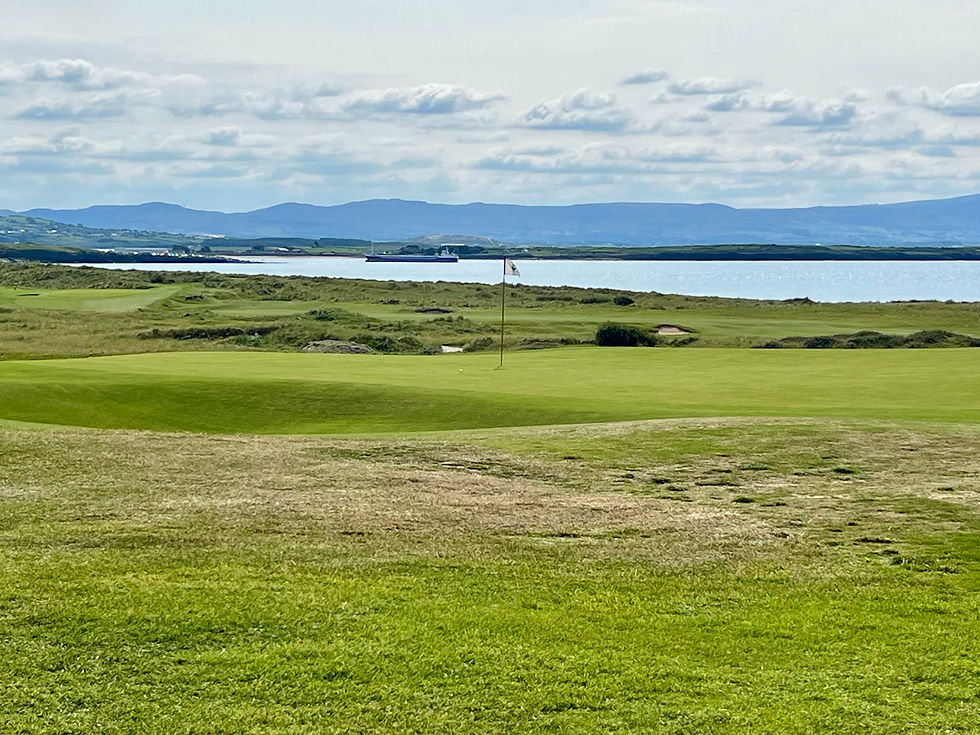
I hit right and thought I had lost my ball. A passing caddie saved the day and enabled me to approach the downhill to a green, beautifully framed by the clubhouse, hotel, and lake.
We mused on this fabulous finale and the wonderful links on the veranda of the high-quality clubhouse with a delicious pizza after the game.

I also learned much about modern media from two of the best ball-strikers we have encountered.
It was a great day at County Sligo.



Comments